Aether-Edge
Decentralized, edge-native predictive HVAC control that cuts comfort violations by 76% and peak temperature overshoot by 90% — at zero Age of Information.
Overview
Aether-Edge is a decentralized, predictive building management system designed to address a fundamental flaw in traditional centralized HVAC control: data staleness. By moving computation to the edge — directly onto sensor nodes — Aether-Edge eliminates the round-trip latency that causes comfort violations and energy waste in conventional architectures.
Problem Statement
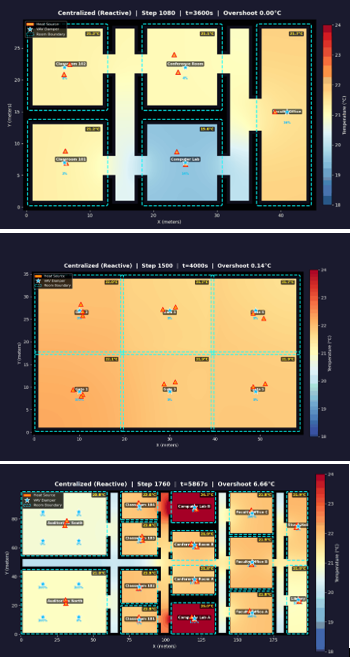
Centralized Building Management Systems (BMS) operate on a poll-compute-push cycle: sensors send readings to a central controller, which computes control decisions and pushes commands back. Under network load or sensor failure, this cycle introduces significant Age of Information (AoI) — the staleness of the data the controller is acting on. In a simulated 5-zone university building floor, the centralized baseline produced an average AoI of 19.4 seconds, resulting in measurable comfort violations (temperature overshoot) and unnecessary cooling plant usage.
Approach
Edge-Native Architecture
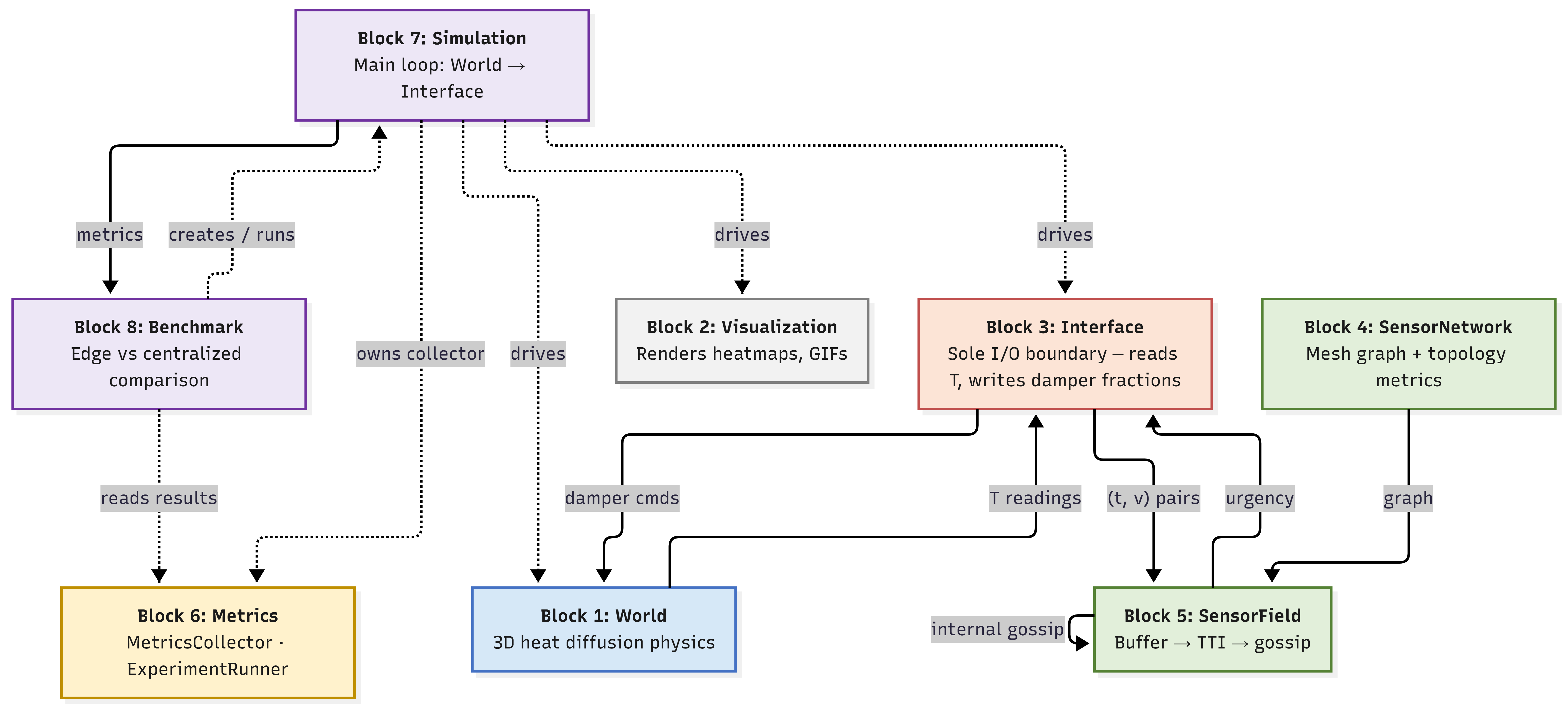
Rather than polling a central server, each zone's sensor node runs a local prediction model. The node fits a rolling-buffer regression over its recent temperature history to forecast where the zone is heading, and makes control decisions (e.g., whether to activate cooling) on that forecast rather than a stale past reading. Shared HVAC capacity is allocated between zones through a threshold-triggered gossip protocol — nodes only exchange messages when their local state crosses a contention threshold, keeping coordination overhead minimal.
Physics-Based Benchmarking
To benchmark the architecture, ground-truth thermal dynamics are generated by a custom 3D thermal physics engine — a Finite-Time Centered-Space (FTCS) heat diffusion solver that discretizes the heat diffusion PDE across each zone's spatial grid using known thermal parameters (wall conductivity, occupant heat load, HVAC capacity). This provides a physically faithful environment for comparing edge-native control against centralized polling baselines across three multi-zone building layouts.
Network Topology Simulation
NetworkX was used to model the sensor network topology — nodes represent sensor/actuator pairs per zone, and edges represent inter-zone thermal coupling and communication links. This allowed the simulation to model scenarios where nodes share state with neighbors to improve boundary-zone prediction accuracy.
3D Visualization
PyVista rendered the building floor as a 3D volume, with temperature distributions color-mapped across the spatial grid. This made it straightforward to visually verify that the FTCS solver was producing physically plausible heat diffusion patterns.
Testing
The project includes 190+ unit and integration tests covering the FTCS solver correctness, network topology construction, edge prediction accuracy, and end-to-end comfort metric computation. All tests are JSON-driven and configurable via a central config file.
Results
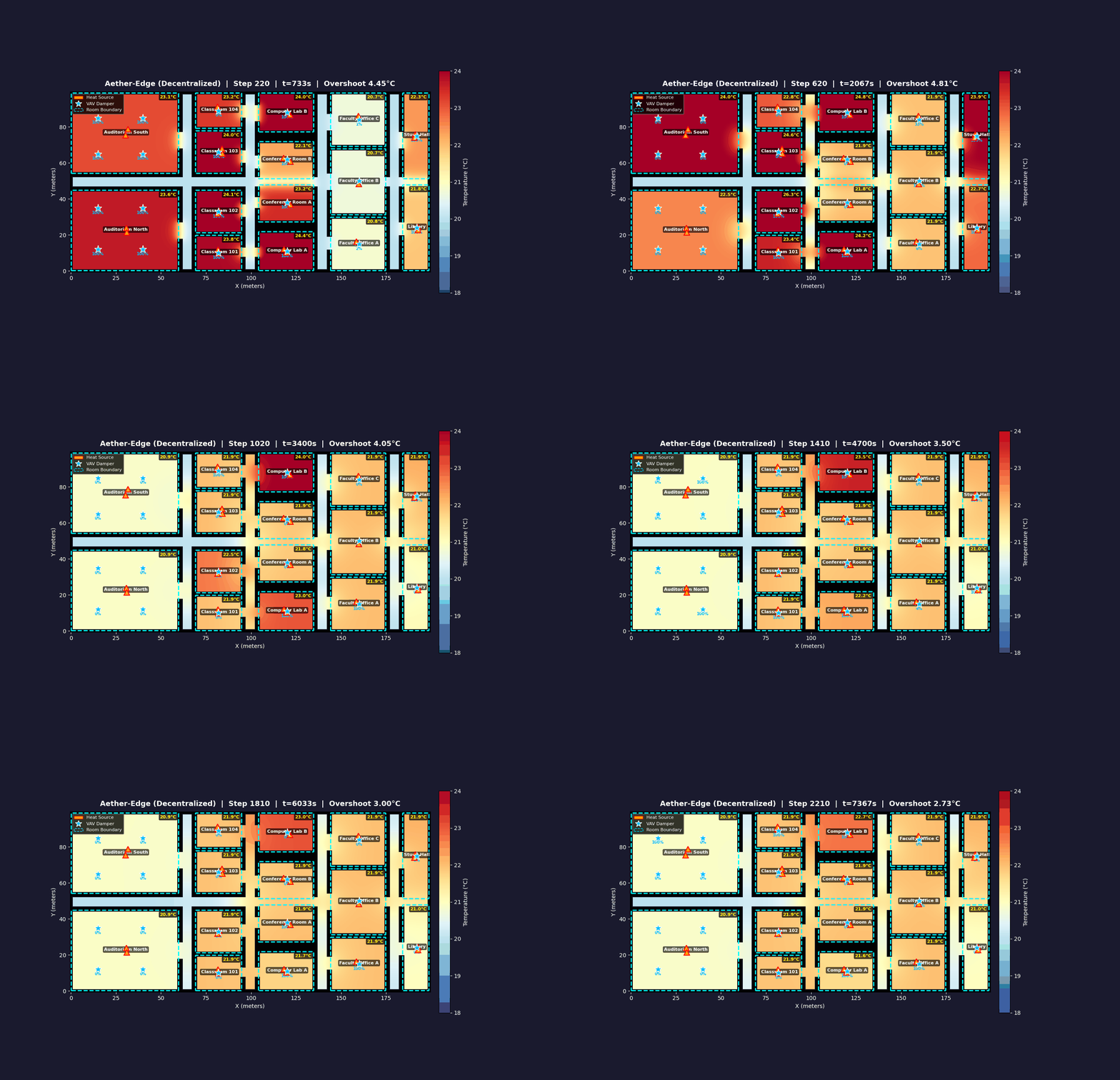
Up to 76% fewer comfort violations and a 90% reduction in peak temperature overshoot versus centralized polling baselines — achieved while driving Age of Information from 19.4 seconds to effectively zero.
- 76% reduction in comfort violations (time-integrated temperature overshoot) across the benchmark environments.
- 90% decrease in peak temperature overshoot — local prediction reacts before a centralized controller would even receive the reading.
- Zero Age of Information: each node acts on a local rolling-buffer regression forecast rather than a stale polled value, so control decisions are never made on out-of-date state.
- Benchmarked across three multi-zone environments via a custom 3D thermal physics engine, with 190+ JSON-driven tests making it straightforward to benchmark new building topologies.
Reflection
This project reinforced how critical the Age of Information metric is in real-time control systems — it's not just about bandwidth, but about whether your controller is making decisions on current reality. The FTCS solver was the most challenging component to validate; getting the boundary conditions right at zone interfaces required careful numerical analysis. Future work could integrate a learned thermal model (e.g., a small neural network) to replace the physics-based FTCS solver for zones where the thermal parameters are uncertain.
Assets